Science News
The science world is buzzing with claims about major mathematical breakthroughs, particularly surrounding the Riemann hypothesis, with multiple reports suggesting AI may have solved the most important problem in mathematics through work by Anthropic. Beyond mathematics, today's headlines also feature developments in astronomy including Sir Brian May's contributions to the Hera asteroid mission and observations of a giant star consuming its neighbor before exploding, while other stories cover practical innovations like geothermal energy solutions for data centers and NASA's evolving lunar exploration plans.
Fire amoeba breaks heat tolerance record for complex life
An amoeba living in a Californian hot spring is thriving above 60°C, a threshold previously thought deadly to complex life
Quantum information spreading via higher-order operator correlators
Researchers introduce N-Operator Correlators (NOC), a generalized extension of Out-of-Time-Ordered Correlators, to…
Developing El Niño becomes strongest on record weeks before expected peak
Scientists say the developing El Niño is now the strongest on record with weather impacts already being felt around the…
Should we use GLP-1 drugs to treat obesity in children?
Children as young as 8 in the US are being prescribed off-label GLP-1 weight-loss drugs, sparking debate about the…

Monks Erased an Archimedes Manuscript, and Science May Have Lost Centuries
In 1906, Danish philologist Johan Ludvig Heiberg spotted faint traces of Archimedes beneath a medieval prayer book, a…
What California is learning from solar panels built over irrigation canals
California is testing solar panels installed over irrigation canals in Turlock through "Project Nexus," a pilot program…
7 out of 9 Planetary Boundaries are breached
Seven out of nine Planetary Boundaries—scientifically defined limits that ensure Earth's stability and habitability—have…
Dramatic gannet dive wins Bird Photographer of the Year competition
Henley Spiers took the top award in the annual contest, with shots of guillemots, penguins and a protective tawny…
The NASA/ESA Mars Sample Return mission has been canceled
Swimmer made of quantum light breaks Newton’s third law
According to Newton’s third law, all actions are paired with reciprocal reactions.
The collapse of the AMOC would be catastrophic. How will we know when it’s coming?
Europe faces incredibly harsh winters and unrelenting droughts if the vital AMOC ocean current fails – but when disaster…
The Claude Delusion
The article explores how humans are naturally predisposed to detect intention and meaning in things, using the analogy…
One-Electron Universe
The one-electron universe is a hypothesis proposed by physicist John Wheeler in 1940 suggesting that all electrons and…
Mathematical Billiards (2024)
Mathematical billiards studies the idealized trajectories of balls bouncing inside custom-shaped, frictionless tables…
Do birds have accents? the regional differences in birdsong
Birds exhibit regional dialects and accents in their songs, with the same species singing noticeably different…
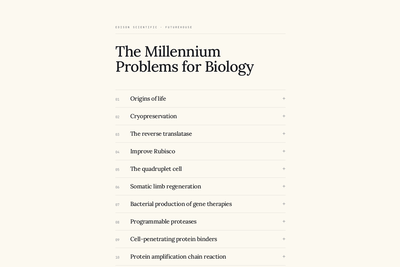
The Millennium Problems for Biology
The article proposes three major scientific challenges for biology analogous to the Millennium Prize Problems in…
T. rex teeth indicate it ran as warm as an elephant
Isotope ratios provide a hint that the giants were actively managing temperatures.
Largest wildlife overpass in North America reduced wildlife collision by 91%
Learning Another Language May Be One of the Best Ways to Keep Your Brain Healthy
Learning another language engages multiple complex mental processes simultaneously—including memory, pattern…
Learning another language may be one of the best ways to keep your brain healthy
Research suggests that bilingualism can offer cognitive benefits.
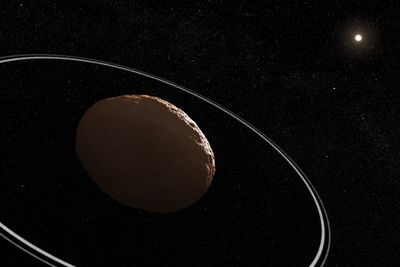
Rings around a tiny body have changed over the past decade
Chariklo is only about 250 km across, but it has two rings, and they're changing.
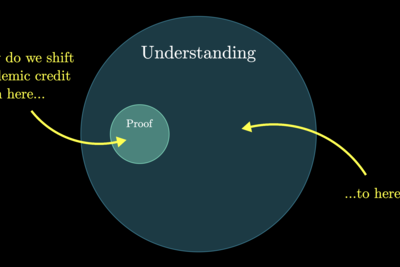
If math is more than proof, we need to better celebrate the rest of it
Grant Sanderson argues that mathematics should place greater value on "motivated explanations"—clear, intuitive accounts…
Human brain is two separate organs, Stanford Medicine-led research finds
Stanford Medicine researchers discovered that the human brain consists of two distinct organs that evolved…
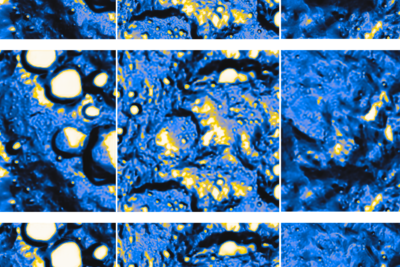
NASA-IBM Lunar Foundation open-Source Geospatial AI Model
NASA and IBM have released an open-source artificial intelligence model trained on nearly two million lunar datasets…
Science Is Open Software
The author argues that modern computational science is fundamentally open source software, as science requires testable,…
Finding the cells that put our brain to sleep
Rare cells with widespread connectivity seem to be able to trigger sleep.
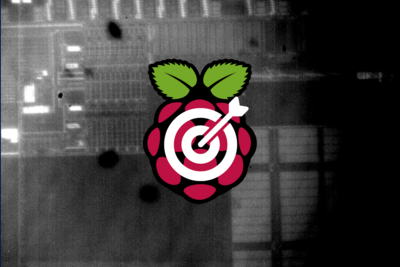
Photon-Emission-Guided Laser Fault Injection Enables RP2350 Secure Debug
Researchers used photon-emission microscopy and laser fault injection to bypass security features on the Raspberry Pi…
Black Holes or Black Hole Stars? Astronomers Spar over 'Little Red Dots'
The James Webb Space Telescope has detected mysterious "little red dots" throughout the early universe that astronomers…
Our brain evolved from two primitive nervous systems that merged: Study
Researchers at Stanford University discovered that the human brain evolved from two separate primitive nervous systems…
North Korean nuclear test sets off years of earthquakes
https://archive.is/xjmvA Comments URL: https://news.ycombinator.com/item?id=49755160 Points: 33 # Comments: 23