Science News
The science world is buzzing with claims about major mathematical breakthroughs, particularly surrounding the Riemann hypothesis, with multiple reports suggesting AI may have solved the most important problem in mathematics through work by Anthropic. Beyond mathematics, today's headlines also feature developments in astronomy including Sir Brian May's contributions to the Hera asteroid mission and observations of a giant star consuming its neighbor before exploding, while other stories cover practical innovations like geothermal energy solutions for data centers and NASA's evolving lunar exploration plans.
Show HN: What if the speed of light was 5 km/h?
This interactive visualization demonstrates relativistic physics by simulating a world where the speed of light is only 5 km/h instead of 300,000 km/s.
I'm sorry, you're not going to die from an AI-engineered supervirus
An economist's article warning about AI-designed superviruses lacks credibility, according to a computational biologist…
AI Is Solving Math's Best Problems Faster Than They Can Be Replaced, Terence Tao Warns
The Fields medalist points to a real race between OpenAI and Anthropic as proof: AI can now flatten a hard problem the…
Europe may finally have found a space entrepreneur who is meeting the moment
"We will not be relevant without a massive rocket at a massive cadence."
Factoring RSA 260
Researchers at Cognition successfully factored RSA-260, a 260-digit number, setting a new record for the largest…
When it comes to Beatles references, scientists can't let it be
New study detects 3,200 references to Beatles song titles and lyrics in academic papers.
Why our common ancestor with chimpanzees keeps getting further away
The more we learn about chimpanzees, the more they resemble us – but the further back in time our shared ancestor seems…
The quick guide to fall vaccines and when you should get them
Here are the evidence-based recommendations and this year's vaccine rollout.
Earliest evidence of habitual drug use found in teeth in Indonesia
Strange, rounded grooves in prehistoric teeth are thought to have been made by regularly sucking whole betel nuts to…
Heat spikes over Tibet may help explain severe Californian flooding
Unusually high temperatures over the mountainous region can kick-start a chain of events that ultimately leads to a…
Bursts of ‘pink noise’ during sleep seem to help clear waste from brain
The human brain flushes out waste products while we sleep and now it seems that certain sounds might enhance the process
Are anti-black holes possible, and how could we tell if we were looking at one?
One reader thinks the answer is yes, and gives ways we could spot them
Why do humans have a common sense of beauty for things like sunsets and do other animals share this appreciation?
Although one reader thinks it would be virtually impossible to tell if animals have a sense of beauty, they give their…
What changes will occur on Earth as the moon moves further away? part 3
A reader thinks outside the box on ways to mitigate against this slow-forming issue
Tom Gauld on an introduction to basic philosophical astronomy
Tom Gauld's weekly cartoon
Unexpected hints of dark matter should breathe life into particle physics
With little in the way of significant discoveries since 2012, there have been mutterings that particle physics is at a…
New Scientist recommends a fascinating deep dive into the real Vikings
The stories we tell about the Vikings often say more about us than them.
Why don’t we sneeze when we are asleep? part 2
It turns out some of our readers do sneeze in their sleeps – but only in certain circumstances
Why don’t dogs look up when a low-flying plane passes overhead? part 3
Readers continue to share stories of how their own dogs respond to aircrafts
This week’s new questions
Why do people appear younger and better-looking in a mirror than in a photograph? Are humans the only animals that cry?
Google's AI genome system evaluates every possible one-base change
Most one-base changes to the human genome do nothing, but a few are significant.
NASA’s next major telescope might see alien oceans and rainbows
The upcoming Habitable Worlds Observatory should be able to spot the glint of water on habitable planets, and maybe more
We Accidentally Built a Synthetic Cell Factory
b.next, founded to improve interoperability in synthetic cell research, unexpectedly became a manufacturer of…
Lost quantum traces could reveal dark matter at the Large Hadron Collider
Particle collisions are inherently quantum, but much of that character is lost when we turn them into classical data.
Denisovan tools from cave in China shows how mysterious humans lived
A site in China is just the third to give us an insight into the way the enigmatic Denisovans lived.
Investing in Mothers? The Long-Run Impact of a Universal Child Care
A study examining Quebec's universal child care program finds that subsidized child care has lasting positive effects on…
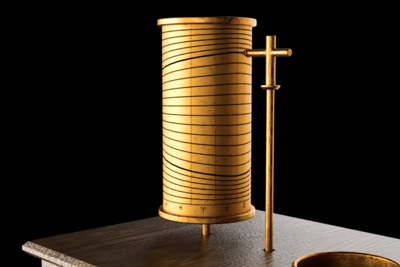
The Ancient Greek Water Clock That Kept the Most Accurate Time for 1,800 Years
In the third century BC, Greek inventor Ctesibius created an automatic water clock that maintained more accurate…
Liesegang Rings
Liesegang rings are geometric patterns that form in gels through chemical reactions, following a mathematical spacing…
Teen reading slumps to worst this century due to surge in screen time
Teenagers' reading scores have hit their worst levels this century, declining from 501 to 466 on the OECD's 2025…