Science News
The dominant science news story today concerns Claude AI's potential breakthrough regarding the Riemann hypothesis, a 167-year-old mathematical problem considered one of the most important unsolved questions in mathematics, with multiple outlets reporting that Anthropic may have achieved what many describe as a "holy grail" proof. Beyond mathematics, the day's science headlines also feature developments in exascale computing for fusion simulations, an upcoming NASA Moon mission, and observations of a giant star consuming its neighbor in a stellar explosion. Other lighter stories round out the coverage, including the history of golf ball dimples, insect photography, and Queen guitarist Brian May's contributions to asteroid research.
The mysterious reason why women get warmer from age 18 to 42
Women experience a steady rise in body temperature from their teens to midlife, which may be useful for monitoring ageing and overall health
The mysterious reason why women get hotter from age 18 to 42
Women experience a steady rise in body temperature from their teens to midlife, which may be useful for monitoring…
Chickens without eggs? De-extinction company creates artificial egg.
In the process, Colossal may have handed a useful tool to developmental biology.
Photos reveal unexpected details from the world's first atomic test
Previously classified photos and documents show the scientific work that went into the world's first atomic test in 1945…
How a visit to Stonehenge reminded me of deep time
On a visit to the UK, Sydney-based reporter James Woodford visited an archaeological site that was on his bucket list –…
Can we harness quantum effects to create a new kind of healthcare?
Experiments hint that quantum mechanisms are vital to the machinery of life.
PMOS shows us why many scientific terms need to be renamed
Like covid-19 and mpox before it, the decision to relabel PCOS as polyendocrine metabolic ovarian syndrome is a welcome…
New Scientist recommends a devastating account of farming honeybees
Jennie Durant's Bitter Honey is a great exposé of the true cost of industrially farming US honeybees, finds Thomas…
Shiver me timbers: Do we have to worry about space pirates now?
Feedback goes down a "moon warfare" rabbit hole and discovers that some forward-thinkers are making plans to counteract…
Putting CO2 into rocks and getting hydrogen out is climate double win
Storing carbon dioxide in rocks while producing hydrogen from them - and perhaps even geothermal power too - could be a…
We could generate hydrogen from rocks while storing CO2 in them
Storing carbon dioxide in rocks while producing hydrogen from them - and perhaps even geothermal power too - could be a…
The Selfish Gene at 50: Why Dawkins’s evolution classic still holds up
When Richard Dawkins’s first blockbuster book was published half a century ago, few genes had ever been sequenced or…
Intoxicating and astonishing: Why 'The Selfish Gene' almost never was
Fifty years ago, a draft of Richard Dawkins’s first book landed on book editor Michael Rodgers’s desk – and life was…
After news about Oliver Sacks's "lies", we revisit his best-loved book
Last year, The New Yorker revealed the late Sacks's "guilt" about his “falsification” in The Man Who Mistook His Wife…
More die of suspected Ebola as WHO warns that numbers will rise further
In its latest update, the World Health Organization says there have now been 139 suspected deaths and 600 cases.
There's no earthly way of knowing which direction we are going
# Summary A nonfiction book about artificial intelligence and truth was found to contain multiple fake and…
Japan is gripped by mass allergies. A 1950s project is to blame
Japan is experiencing a nationwide allergy crisis affecting 43% of its population, traced back to a 1950s reforestation…
We may finally know why dinosaurs like T. rex evolved tiny arms
Five different groups of predatory dinosaurs independently evolved disproportionately small arms, and it seems they did…
"I'll buy 10 of those"—NASA science chief yearns for mass-produced satellites
"How in the hell do I get more science into space? That is my goal."
'Ebola has tortured us': Fear grips eastern DR Congo as deadly virus spreads
The health minister has acknowledged that medics are playing catch-up with the virus after being slow to detect it.

'Comically bad' datasets used to train clinical models for stroke and diabetes
Researchers discovered that datasets hosted on Kaggle and used to train clinical prediction models for stroke and…
The distant world that is our best hope of finding alien life
A decade ago, we discovered an exceptionally exciting exoplanet that could be the best candidate for hosting alien life.
Solar farm on the ocean outperforms land-based solar in Taiwan
A solar farm in a tidal bay has generated more electricity and profits than a nearby coastal solar farm, but challenges…
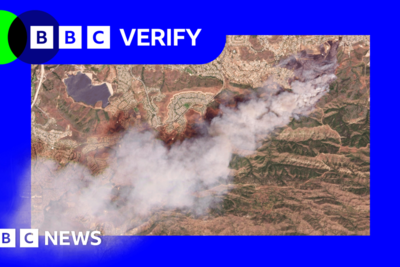
How two new California wildfires look from space
Satellite images reveal the scale of two wildfires that have broken out in southern California.
Wind-assisted cargo ships could more than halve shipping emissions
If wind-assisted cargo ships chose routes based entirely on where the winds are better, their fuel use could be cut in…
Colonization of Venus
Venus colonization proposals focus on floating habitats in the upper atmosphere rather than surface settlements due to…
Colossal claims an artificial eggshell will help it bring back the moa
Colossal Biosciences, the company that says it resurrected the dire wolf, now says it has developed artificial eggshells…
Odd “butterfly” molecule could lead to new parts of the quantum realm
An exotic new molecule is shaped like a butterfly, complete with "wings" made from electrons.
Solar to dominate energy by 2035, but AI data centers will keep fossil fuels in business
Costs for solar panels are expected to drop another 30% in the coming decade, helping the tech cement its lead in energy…