Dirac's Theorem at a Dinner Party
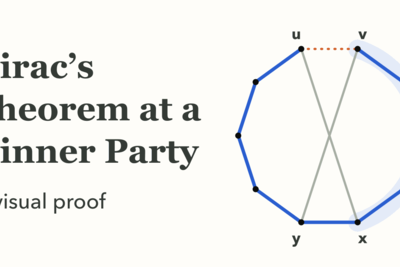
Gabriel Dirac formulated an important theorem stating that if a graph has n vertices where each vertex has at least n/2 neighbors, then the graph contains a Hamiltonian cycle (a path visiting every vertex exactly once and returning to the start). The theorem can be intuitively understood through a dinner party analogy: if every guest at a party is friends with at least half the other guests, they can be seated at a round table so each person sits between two friends. This foundational result has since been generalized by mathematicians into broader theorems applicable to wider ranges of graphs.